
What Is A Lionfish? Unveiling The “Venomous Royalty” Of Con Dao’s Marine Life
The Lionfish (Pterois) is a predatory reef fish belonging to the Scorpaenidae family, renowned for its elongated, ornate fins and venomous dorsal spines. In the Marine Life ecosystem of Con Dao, Vietnam, they are a vital native predator that helps maintain coral reef balance. To observe them safely, divers must maintain excellent neutral buoyancy and keep a minimum distance of 1.5 meters.
The ocean is a realm of mesmerizing beauty often paired with concealed defenses. During any underwater journey through the vibrant biodiversity of Marine Life, the Lion Fish stands out as an absolute showstopper, moving gracefully across the reef like a flamenco dancer.
However, beneath this flamboyant display lies a formidable defense mechanism. Guided by our core philosophy of “Safety First & Eco-friendly Diving,” our expert instructors at Amadive Con Dao Dive Center are excited to share deeply technical insights into this magnificent creature and how to experience encounters with them safely.
Biological Features And Envenomation Anatomy Of The Lionfish
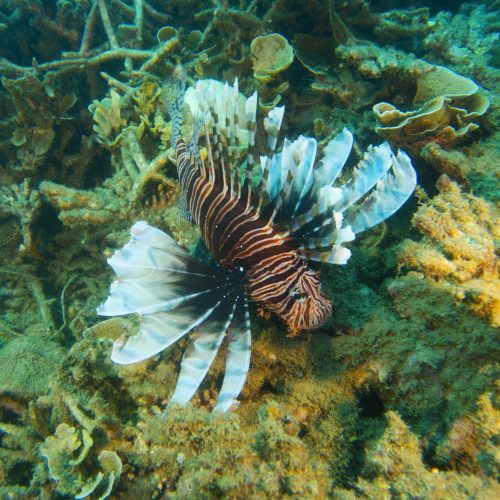
Lionfish are easily distinguished by their striking zebra-like stripes of red, white, and brown, complemented by fan-like pectoral fins. Hovering motionlessly or swimming slowly, they blend seamlessly into the surrounding coral seascape.
The Defensive Arsenal: Where Is The Venom Stored?
A mature Lion Fish possesses 18 venomous spines (13 dorsal spines, 3 anal spines, and 2 pelvic spines). Each spine acts as a hypodermic needle surrounded by a sheath containing glandular venom-producing tissue rich in neurotoxic proteins.
-
Defense Mechanism: When threatened, a lionfish lowers its head and points its dorsal spines directly toward the perceived threat.
-
Impact: While envenomation is rarely fatal to healthy humans, a sting causes extreme localized pain, swelling, nausea, and dizziness.
Lionfish In Con Dao: Native Protectors Or Invasive Pests?
You may have seen international headlines regarding lionfish as an ecological catastrophe destroying reefs in the Caribbean and Atlantic Ocean. However, marine biogeography tells a completely different story here in Vietnam!
In the Indo-Pacific region, which includes the pristine Marine Life of Con Dao and Phu Quoc, the Lion Fish is a native species. Here, they exist harmoniously within the natural food web, kept in check by apex predators such as giant groupers, moray eels, and reef sharks. By culling weak and diseased forage fish, native lionfish actually preserve reef health.
Thanks to Amadive’s special approval from Con Dao National Park to access strictly protected and tourist-limited dive sites, Amadive Con Dao Dive Center regularly takes divers to witness thriving, healthy populations of native lionfish in their natural habitat.
Quick Facts & Specifications: The Lionfish
| Feature | Details / Specifications |
| Average Size | 30 – 35 cm (Can reach up to 43 cm in the wild) |
| Habitat | Coral reefs, rocky crevices, and shipwrecks at depths of 2 – 50m |
| Behavior | Primary hunters during dawn and dusk (Crepuscular / Nocturnal) |
| Venom Locations | 13 dorsal spines, 3 anal spines, 2 pelvic spines |
| Diet | Small reef fishes, crustaceans, shrimps, and crabs |
Amadive’s 4 Golden Rules For Safe Lionfish Encounters
At Amadive, your safety is our utmost priority. To enjoy world-class Lion Fish sightings without risk, our certified instructors enforce strict protocols:
-
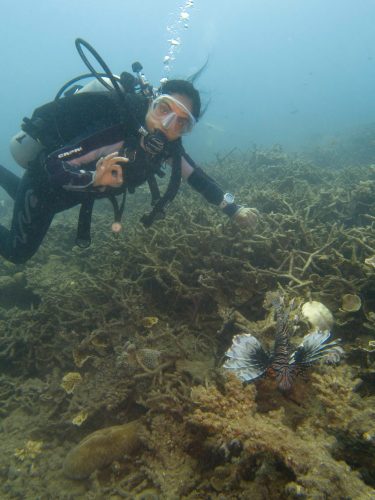
Master Peak Performance Buoyancy: Maintain impeccable neutral buoyancy to prevent accidental contact with the reef structure where lionfish hide.
-
Strict “No-Touch” Policy: Never use hands, reef hooks, pointers, or camera housings to harass, touch, or corner marine life.
-
Mind Your Clearance: Lionfish are confident swimmers and rarely flee from divers. Proactively maintain a safe clearance distance of at least 1.5 meters (5 feet).
-
Small Group Advantage: We strictly limit our expeditions to 4 to 6 divers per group. This personalized 1:4 ratio allows Amadive’s Divemasters and Instructors to monitor your environment constantly and point out camouflaged hazards like lionfish or stonefish.
How to Master Neutral Buoyancy for Scuba Divers
FAQ Section: Frequently Asked Questions About Lionfish
1. Is a lionfish sting fatal to humans?
Fatalities are exceptionally rare among healthy adults. However, the venom causes excruciating pain and can trigger anaphylactic reactions in allergic individuals. Immediate and proper first aid is essential.
2. What should I do if I accidentally get stung underwater?
Remain calm, immediately signal your Instructor using scuba hand signals, and end the dive safely. Following standard DAN (Divers Alert Network) medical protocols, immerse the affected area in hot water (45°C – 50°C, or as hot as tolerable without causing burns) for 30 to 90 minutes. Heat denatures the protein-based venom, rapidly relieving the pain.
3. At what depths can I see lionfish diving in Con Dao?
They can be spotted across a wide depth range from 5 to 25 meters. During daytime fun dives with Amadive Con Dao Dive Center, you will often find them resting beneath table corals or inside overhang crevices.
Exploring the diverse Marine Life of the undersea world is an unforgettable adventure, and spotting a magnificent Lion Fish is an absolute highlight for any ocean enthusiast. Equipped with accurate scuba knowledge and situational awareness, you can admire their regal beauty with 100% confidence.
Offering multi-day diving itineraries with rotating daily dive sites and an exclusive small-group guarantee (4-6 pax), Amadive is ready to lead your personalized, eco-friendly, and ultra-safe diving journey in Con Dao. Contact us today!
About The Author
Kevin Tu – Founder Amadive | PADI – SSI Instructor Scuba Diving
With 10 years of professional experience leading dives across Vietnam’s most challenging waters, I founded Amadive with a commitment to international safety standards and a deep love for the marine ecosystems of Con Dao and Phu Quoc.
Dive Safety & Truly Experience Diving in Con Dao with Amadive!
🌐 Website: www.amadive.com.vn
📲 WhatsApp: +84392419241
📧 Email Reservation: book.amadive@gmail.com